Publications

African Governments are Primarily Responsible for Climate Action, According to Their Citizens, with Talbot M. Andrews, Nicholas P. Simpson, Andreas L.S. Meyer, Christopher H. Trisos, and Debra Roberts, 2025, Communications Earth & Environment.
Abstract
Global increase in the pace of climate action is urgent. Yet, it is less clear who citizens expect to take the lead on climate action across different regions of the world: historical emitters, their own governments, or themselves? Our analysis of Africa’s largest public opinion survey, the Afrobarometer, across 39 countries finds that Africans place primary responsibility for addressing climate change on their own government, a further third see ordinary citizens as most responsible, while very few place responsibility on historical emitters. Multinomial logistic regression analysis shows that education, decreased poverty, and access to new media sources are associated with increased attribution of responsibility to historical emitters. Our results suggest that poverty alleviation and increased access to education, combined with professional frontline government bureaucracies can re-apportion citizen expectations of responsibility for climate action onto historical emitters and actors with more resources for scalable climate action.

African Legislators: Unrepresentative Power Elites?, with Robert Mattes and Shaheen Mozaffar, 2024, Journal of Southern African Studies.
Abstract
African legislators both resemble and differ from the societies they claim to represent in important ways. Based on a unique survey of representative samples of parliamentarians in 17 countries, we find that legislatures are representative of national publics in terms of ethnicity and religion. At the same time, compared to ordinary African citizens, their MPs possess far higher levels of education, and are far more likely to be older, male, and come from professional or business backgrounds. Besides coming from higher social and economic status backgrounds, many MPs also previously held senior posts in the state and national government, or leadership positions in their political party. Does this mean that African legislators constitute a coherent, self-interested, social, economic and political ‘power elite’ detached from the interests of the voters? In the legislatures under investigation, we find little evidence of this effect. Markers of social, economic or political privilege and power overlap irregularly and in a non-cumulative way. Thus, far from comprising a slowly changing, cohesive and self-interested elite, Africa’s legislators come from a plurality of social and political backgrounds, and are relative legislative neophytes.
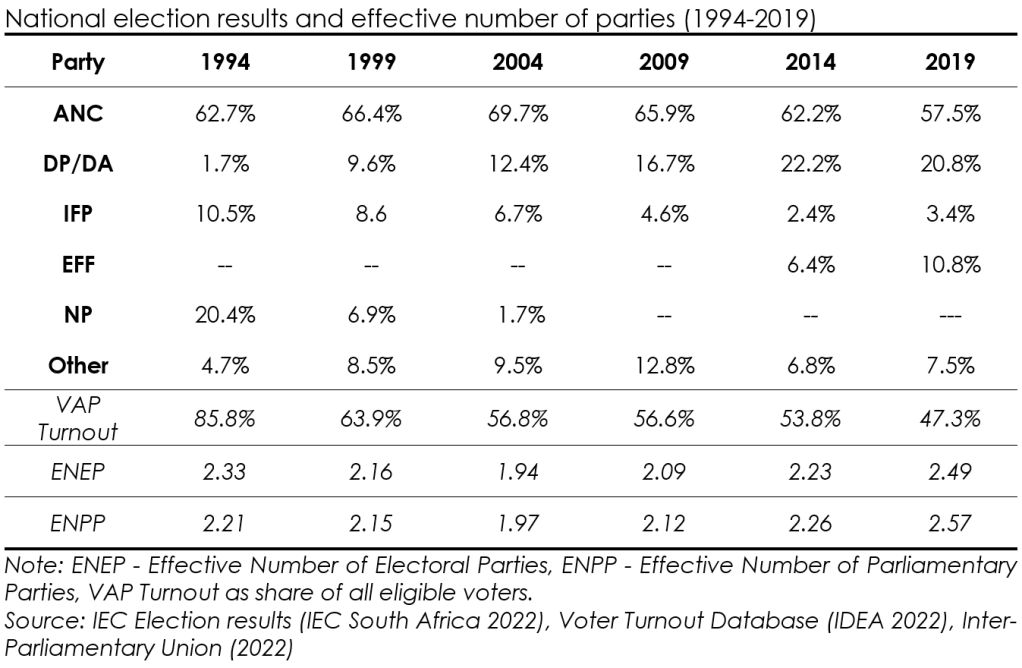
Political Parties and Democracy in South Africa, with Robert Mattes and Sarah J. Lockwood, 2024, in Poguntke, T and Hofmeister, W. (eds), Political Parties and the Crisis of Democracy: Organization, Resilience, and Reform | Publisher’s website (Open access)
Abstract
Nearly thirty years after the fall of apartheid, South African voters confront a party system that is still marked by continued dominance of the governing African National Congress (ANC) and a field of small opposition parties, most of which still have their roots in the old regime or the struggle against it. Neither the ANC nor the opposition succeed in engaging large proportions of voters in election campaigns, and opposition parties generally fail to offer effective alternatives on the issues people care about most. Unsurprisingly, dissatisfied voters tend to exit the electorate rather than switch their vote and voter turnout has declined by more than thirty percentage points over this period. Thus, South Africa’s parties have, collectively, weakened the country’s democratic experiment by failing to offer its citizens a competitive electoral arena with effective choice.

Where are the Sore Losers? Competitive Authoritarianism, Incumbent Defeat, and Electoral Trust in Zambia’s 2021 Election, with Nicholas Kerr and Michael Wahman, 2024, Public Opinion Quarterly.
Abstract
How do electoral turnovers shape citizen perceptions of election quality in competitive authoritarian regimes? In this paper, we argue that electoral outcomes are crucial for determining perceptions of electoral quality. While detailed evaluation of electoral trust is complex in competitive autocracies with institutional uncertainty and polarized electoral environments, turnovers send strong and unequivocal signals about election quality. Previous literature has noted a strong partisan divide in electoral trust in competitive authoritarian regimes, but turnovers can boost trust among both incumbent and opposition supporters. We test this argument in the case of Zambia’s 2021 election, a case where a ruling party lost an election despite electoral manipulation and strong control over the Election Management Body. Using data from the first-ever panel survey carried out during Zambian elections, we compare trust in elections before and after the election. We find that perceived election quality increased after the 2021 electoral turnover among both losers and winners. Trust in elections increased the most among winning opposition supporters. Moreover, despite the outgoing president’s attempt to portray the election as fraudulent, losing ruling-party supporters also increased their trust in elections after the turnover. The study has important implications for the literature on democratic consolidation and institutional trust.

Drivers of Political Participation: The Role of Partisanship, Identity, and Incentives in Mobilizing Zambian Citizens, with Prisca Jöst, Sarah J Lockwood, and Ellen Lust, 2024, Comparative Political Studies.
Abstract
Scholars and policymakers widely view identity as a key driver of African citizens’ political engagement. In doing so, however, they have emphasized ethnicity and largely sidelined other identities, including gender, local origin, shared residency, and partisanship. In this paper, we explore which identities drive political engagement and why they do so. We employ an original survey experiment that includes various identities and other incentives that may drive citizens’ participation around Zambia’s 2021 national elections. We find that partisanship most influences individuals’ stated willingness to campaign for a candidate or meet with an MP, while ethnicity and social incentives play less significant roles. Finally, we explore the mechanisms underpinning these results and find that citizens anticipate sanctions if they fail to support a co-partisan but not a co-ethnic candidate. These findings have important implications for understanding political engagement and democratic development throughout the region.

Lack of ownership of mobile phones could hinder the rollout of mHealth interventions in Africa, with Justin T Okanon, Joan Ponce, and Sally Blower, 2022, eLife.
Abstract
Mobile health (mHealth) interventions, which require ownership of mobile phones, are being investigated throughout Africa. We estimate the percentage of individuals who own mobile phones in 33 African countries, identify a relationship between ownership and proximity to a health clinic (HC), and quantify inequities in ownership. We investigate basic mobile phones (BPs) and smartphones (SPs): SPs can connect to the internet, BPs cannot. We use nationally representative data collected in 2017–2018 from 44,224 individuals in Round 7 of the Afrobarometer surveys. We find 82% of individuals in 33 countries own mobile phones: 42% BPs and 40% SPs. Individuals who live close to an HC have higher odds of ownership than those who do not. Additionally, we find that men, urban residents and wealthier citizens are more likely to own mobile phones. If the digital devices needed for mHealth interventions are not equally available within the population (which we have found is the current situation), rolling out mHealth interventions in Africa is likely to propagate already existing inequities in access to healthcare.

Symposium on Party Structures and Organization Building in Africa, with Sarah J. Lockwood, Robert Mattes (Eds), 2022 Party Politics.
The symposium features articles by Aikande Kwayu (“Determinants of a Political Party’s Social Media Strategy: A Comparative Analysis of Tanzania’s Opposition Political Parties’ Twitter Practices“), Dan Paget (“Lone Organizers: Opposition Party Building in Hostile Places in Tanzania“), Consolata Sully (“Democracy within Parties: Electoral Consequences of Candidate Selection Methods in Tanzania“), Shana Warren, “Democratizing Candidate Selection: Controlled Turnover in Botswana’s Bulela Ditswe Primaries“, as well as our paper on Party Footprints in Africa.

Party Footprints in Africa: Measuring Local Party Presence Across the Continent, with Sarah J. Lockwood and Robert Mattes, 2022, Party Politics | Publisher’s version | Pre-Print (Afrobarometer Working Paper No. 186)
Abstract
The conventional view of Africa’s political parties holds that they are organizationally weak, with little presence at the grass roots. Yet, few studies are based on systematically collected data about more than a handful of parties or countries at any given point. In this paper, we attempt to remedy this situation, by focusing on one crucial aspect of party organization – the local presence that enables political parties to engage with and mobilize voters during and between elections – and developing the first systematic, survey-based measure of the extent of this presence across 35 countries. We draw on a wide variety of data to demonstrate the validity and reliability of this new index, and in the process showcase its ability to be calculated at a number of different levels. Finally, we illustrate its utility by applying it to a key substantive question in the literature.
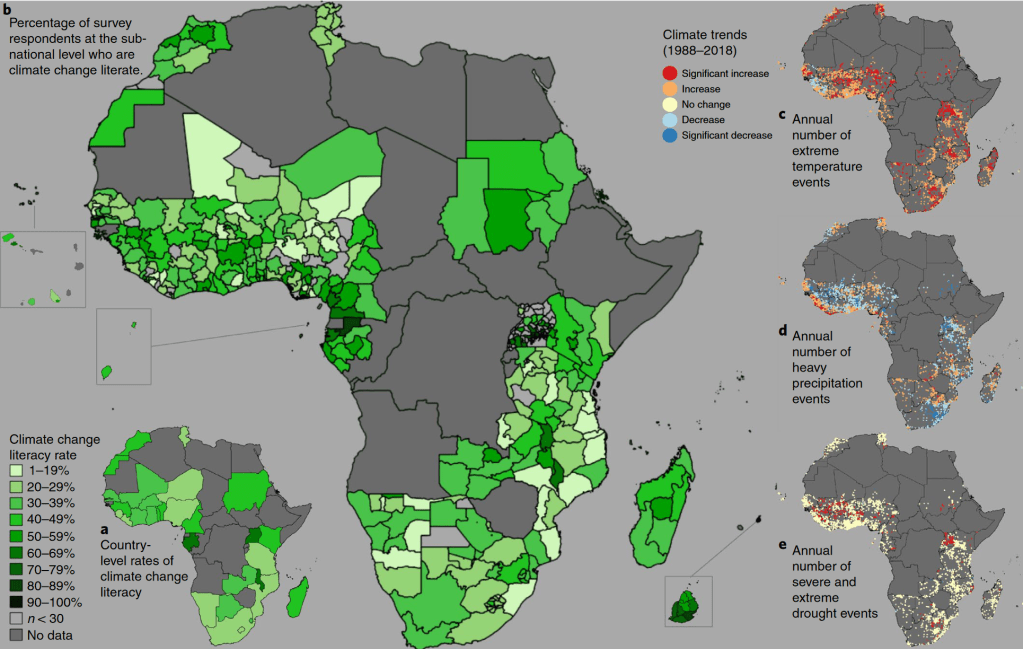
Climate Change Literacy in Africa, with Nicholas Simpson, Talbot Andrews, Chris Lennard, Romaric Odoulami, Birgitt Ouweneel, Anna Steynor, and Christopher Trisos, 2021, Nature Climate Change | Publisher’s version | Open Access version | in The Conversation.
Abstract
Climate change literacy encompasses being aware of both climate change and its anthropogenic cause, and thus underpins informed mitigation and adaptation responses. However, climate change literacy rates and their predictors remain poorly understood across the Global South. Here analysis of Africa’s largest representative public opinion survey shows climate change literacy ranges from 23 to 66% of the population across 33 countries, with larger variation at subnational scales (for example, 5–71% among states in Nigeria). Strong positive predictors of climate change literacy are education and mobility, but poverty decreases climate change literacy, and country-level climate change literacy rates are, on average, 12.8% lower for women than men. Perceived drought experiences and historical trends in precipitation are also important predictors. These results highlight where interventions can target specific regions and demographics to increase climate change literacy and help ensure that responses are informed by better understanding of current and future climate change.

Do Electoral Systems Affect How Citizens Hold Their Government Accountable? Evidence From Africa with Sarah J. Lockwood, 2021, Democratization Publisher’s version| Pre-print (Afrobarometer Working Paper No. 181)
Abstract
This paper asks whether a country’s choice of electoral system affects the methods citizens use to try and hold their government accountable. A large body of literature suggests that electoral system type has an impact on voting behaviour, but little work has been done so far looking at other forms of democratic accountability, such as contacting an elected representative and protesting. Using Round 6 Afrobarometer data, we find that the type of electoral system does indeed have a significant impact on these other forms of participation. Citizens in PR systems are significantly more likely to protest than those in majoritarian ones, while those in majoritarian systems are more likely to contact their elected representatives. We argue that this is because the connection between citizens and representatives in majoritarian systems is clearer, closer and more responsive, making contact an effective strategy and providing an efficient “safety valve” when citizens want to hold their government to account. The lack of a similar connection in most PR systems, in contrast, leads citizens to turn to protest with greater regularity.

The Consequences of Partisanship in Africa: Cognitive Lens or Tribal Straitjacket? with Robert Mattes, 2020, in Oscarsson, H. and Holmberg, S. (eds.) Research Handbook on Political Partisanship | Publisher’s website
Abstract
The paper provides evidence that partisan identification exists in African polities, though its extent varies considerably across countries. Moreover, we find that partisanship helps people organize their political world. It shapes the way they vote, and also exercises important influences on citizens’ propensity to become involved in a wide range of democratic politics, whether during or between elections. Finally, we produce several nuggets of evidence which suggest that partisanship in Africa constitutes, at least for many voters, a ‘standing choice’ rather than a fixed identity. That is, while voter support for ruling parties is shaped by ethnicity (and other demographic background factors), it is not determined by them. Voter evaluations of the overall direction of the economy, national economic trends, and government responsibility for those trends, matter. Moreover, aggregate levels of identification with the ruling party, or what other scholars have called ‘macropartisanship’, have undergone important, and in some cases dramatic, shifts over time. All of this should be seen as evidence of an important, little-appreciated dimension of vertical accountability in Africa’s multi-party regimes.

The 2019 South African Elections: Incumbency and Uncertainty
with Robert Nyenhuis, 2019, Journal of African Elections | Publisher’s version
Abstract
The 2019 South African elections marked the country’s sixth iteration of free and fair electoral contests since its democratisation in 1994. Although the outcome gives the African National Congress (ANC) yet another five-year mandate, the party has not gone unchallenged at the polls. It registered its lowest national vote share since the transition, a major concern for the party of liberation. The most recent contest also demonstrates the resilience of the main opposition party, the Democratic Alliance (DA), and the continued upward trajectory of its closest rival, the Economic Freedom Fighters (EFF). In this article, we analyse available survey data on South Africans’ attitudes and offer some empirical answers to account for the election results. We argue that race continues to feature prominently in electoral decision-making but it does so in ways that deviate slightly from conventional wisdom. Further, we put forth an explanation that the parties’ leaders played a central role in shaping citizens’ voting behavior, especially among their own partisan supporters.
Under Review
African Political Parties: A Citizen Perspective, with Sarah J. Lockwood and Robert Mattes, 2024.
Working Papers
Whom Do African Election Campaigns Contact, And Does It Matter?, with Robert Mattes, and Sarah J. Lockwood, 2025 | Pre-print (Afrobarometer Working Paper No. 208).
Abstract
Canvassing is a key way in which political parties around the world raise awareness and connect with voters. Despite its importance, however, the literature on parties in new democracies, and Africa in particular, has tended to overlook this form of activity. In this paper, we use public opinion survey data from Afrobarometer and the Comparative National Elections Project to show that overall rates of canvassing in Africa are similar to other new, as well as many established, democracies. The data also challenge several dominant views of party campaigns in the Africanist literature. First, African parties do not concentrate primarily on turning out their base, rather than reaching across the partisan divide. Indeed, the opposite is the case. African parties expend more energy contacting non-partisan independents and opposition supporters, and thus, making a potentially meaningful contribution to the supply of multiparty competition. Second, the vast majority of contacts occur without any clientelist exchanges between parties and voters. And third, while incumbent parties enjoy canvassing advantages over opposition parties in around one-third of the surveyed countries, opposition parties match the party in power in terms of the ground game in another third, and enjoy higher rates of contact in yet another third.
Advocates, Ambassadors & Problem Solvers: The Underappreciated Roles of Party Activists in New Democracies, 2024 | Draft.
Abstract
Despite growing interest, party activists in the Global South have received little attention beyond their role as brokers of clientelistic goods and services in exchange for votes. Regarding African party activists in particular, the conventional view is that they have no strong attachment to the party, and thus limited capacity to engage citizens on behalf of the party, or incentive to represent citizens’ views within the party.
However, these assertions are rarely tested systematically in the literature. I aim to address this shortcoming by demonstrating how party activists frequently collect, process, and share information between citizens and bureaucrats. I argue that party activists take on at least one of three roles: problem solver (helping citizens to navigate the bureaucracy), ambassador (advertising their and the party’s achievements to citizens), or advocate (representing citizens’ issue priorities within party structures).
Using an original three-wave panel survey of citizens in Zambia, as well as novel elite surveys of over 700 party representatives and bureaucrats in Malawi, I demonstrate that party activists take on these roles and help to make political parties work as conveyor-belts of information between citizens and the state. I find that party workers spend most of their time serving their communities and contributing to democratic accountability, rather than responding to individuals’ demands for patronage, or clientelist goods and services.
Why do Some African Parties Canvass More Than Others? The Importance of Organisational Investments, with Sarah J. Lockwood and Robert Mattes, 2025.
Abstract
Why do some African parties canvass more citizens than others? Although scholars have long paid attention to different electoral strategies, the overwhelming focus has been on the consequences of the ‘ground game’ (e.g. canvassing, rallies). In this paper we investigate the determinants of this crucial activity for democratic competition. Drawing on Afrobarometer and V-Party data for ca 100 parties across 30 countries, we show that parties’ organisational investments (parties’ grassroots presence / activity, organisational coherence, and links to affiliate organisations) are positively associated canvassing rates. In contrast, a party’s clientelistic practices and incumbency status seem to matter less.
We also add to the literature of country-level effects. Parties operating in more democratic contexts and SMD systems seem to canvass more citizens, while the rise of mass and social media does not (yet) seem to have replaced canvassing efforts.
These findings have important implications for the literature on party building, election campaign strategies, and democratic competition.
.
Clients or Partisan Activists? Party Membership and Mobilization in Africa, with Sarah J. Lockwood, 2025.
Abstract
In Africa, party supporters are often seen as clients in search of material benefits, rather than activists that contribute to and mobilize large political organisations. However, few studies have attempted to actually measure the extent of party activism across Africa. In this paper, we use survey data from more than 30 countries to assess, for the first time, the levels of party activism across the continent. We find that African political parties can rely more on active partisans than expected, and indeed have relatively high numbers of party activists compared to other parts of the world. We also test the relative importance of country-level and socio-economic factors in explaining the variance in activism across our sample. Our findings call into question the dominant arguments around the importance of clientelism in explaining African party activism, highlighting the importance of continuing to study these important actors.
Mapping State Capacity in Africa: Professionalism and Reach, with Robert Mattes and Vinothan Naidoo, 2022 | Pre-print (Afrobarometer Working Paper No. 190).
Abstract
Whether depicted as bloated, extractive, or remote from the lives of ordinary citizens, the African state is widely seen to lack the necessary capacity to provide for the physical and material security of its citizens or to command legitimacy. Yet scholars have rarely attempted to assess the performance of the African state through the prism of the lived experiences of those whom the state is meant to serve – its citizens. Most studies rely on data supplied by national statistics agencies or the judgments of expert observers. And while scholars acknowledge that the quality of the African state is likely shaped by geographic and ethnic differences within countries, few have measured how state capacity varies at the sub-national level. In this paper, we address this situation by using survey research measures of respondents’ proximity to state services and actual experiences with civil servants to measure two distinct dimensions of the state salient to the African context: its reach, or physical presence at the grassroots across the breadth of a country, and its professionalism, or ability to deliver public services in a proficient and ethical manner. The results reveal new perspectives on which states excel on either or both dimensions. They also illustrate how widely state performance varies at the sub-national level. Finally, we use survey data to assess the performance of the state, and show that it is the degree of professionalism, and sometimes reach, that enables the state to provide security and welfare, satisfy demands, and secure popular legitimacy. But in contrast to usual expectations, the size of the state at senior levels has no impact.
Explaining Issue Congruence in Africa: MPs and their Constituents, with Robert Mattes and Shaheen Mozaffar, 2022.
Organizing for Success: The Effect of Intra-Party Democracy on Local Level Party Presence, with Sarah J. Lockwood, 2021.
Works in Progress
Opposition Party Appeals and Political Participation in South Africa, with Robert Nyenhuis and Sarah J. Lockwood.
The Myth of the Paper Tiger? Judicial Independence in Africa, with Chris Oxtoby.
The South African Judiciary, with Chris Oxtoby.
Policy Papers and Reports
Africa’s Digital Divide Is Closing, But Participation In The Digital(ised) Economy Remains Highly Uneven, with Shannon van Wyk-Khosa and Rosevitha Ndumbu, 2025, Afrobarometer Policy Paper No. 95. PDF English.
Was South Africa’s 2024 Election a Win for Democracy? with Rorisang Lekalake, 2025, Afrobarometer Dispatch No. 991. PDF, The Conversation blog post.
Learning from Experience: Are African Governments Prepared for Another Pandemic, with Tunde A Alabi, 2024, Afrobarometer Policy Paper No. 92 (Pan-African Profile). PDF English / French.
Health for Everyone, Everywhere?, 2024, with Lionel Ossé, Afrobarometer Policy Paper No. 91 (Pan-African Profile). PDF English / French.
Law Enforcers or Law Breakers? Beyond Corruption, Africans cite Brutality and Lack of Professionalism among Police Failings, with Thomas Isbell and Makanga Ronald Kakumba, 2024, Afrobarometer Policy Paper No. 90 (Pan-African Profile). PDF English / French, Good Authority blog post, The Conversation blog post (English / French)
With Climate Change Making Life Worse, Africans Expect Governments and Other Stakeholders to Step Up, with Alfred Kwadzo Torsu, 2023, Afrobarometer Dispatch No. 717 (Pan-African Profile).PDF English / French, Good Authority Blog post, Video summary.
Value for Money? Perceived Misuse of Tax Revenue, Corruption and Unfairness Erode Support for Broadening Tax Base in Uganda, with Makanga Ronald Kakumba, 2023, Afrobarometer Policy Paper No. 89. PDF.
Brutality and Corruption Undermine Trust in Uganda’s Police: Can Damage be Undone?, with Makanga Ronald Kakumba, 2023, Afrobarometer Policy Paper No. 88. PDF.
As Local Government Councils Proliferate, Ugandans Voice Growing Dissatisfaction With Councilors, with Makanga Ronald Kakumba, 2022, Afrobarometer Policy Paper No. 83. PDF.
Unresponsive and Corrupt? Ugandan MPs Hold Key to How Citizens Perceive Them, with Makanga Ronald Kakumba, 2022, Afrobarometer Policy Paper No. 81. PDF.
Broad Support for Multiparty Elections, Little Faith in Electoral Institutions: Uganda in Comparative Perspective, 2022, Afrobarometer Policy Paper No. 79. PDF
Public Confidence in the Judiciary: A South African Perspective, with Chris Oxtoby, 2020, Judicial Education and Training (7). PDF
Africa’s Digital Divide and the Promise of E-Learning, 2020, Afrobarometer Policy Paper No. 66. PDF
Democratic dividend: The Road to Quality Education in Africa, with Lulu Olan’g, 2020, Afrobarometer Policy Paper No. 63. PDF
Police in Zimbabwe: Helping hand or iron fist?, with Nicholas Simpson, 2019, Afrobarometer Dispatch No. 296. PDF
Bounded Autonomy: What Limits Zimbabweans’ Trust in their Courts and Electoral Commission?, 2018, Afrobarometer Policy Paper No. 52. PDF
Ill-prepared? Health Care Service Delivery in Zimbabwe, with Thomas Isbell, 2018, Afrobarometer Dispatch No. 240. PDF
Trends in Attitudes Toward Foreigners in South Africa, 1997-2011, 2015, Afrobarometer Dispatch No. 44, 2015. PDF
 Matthias Krönke